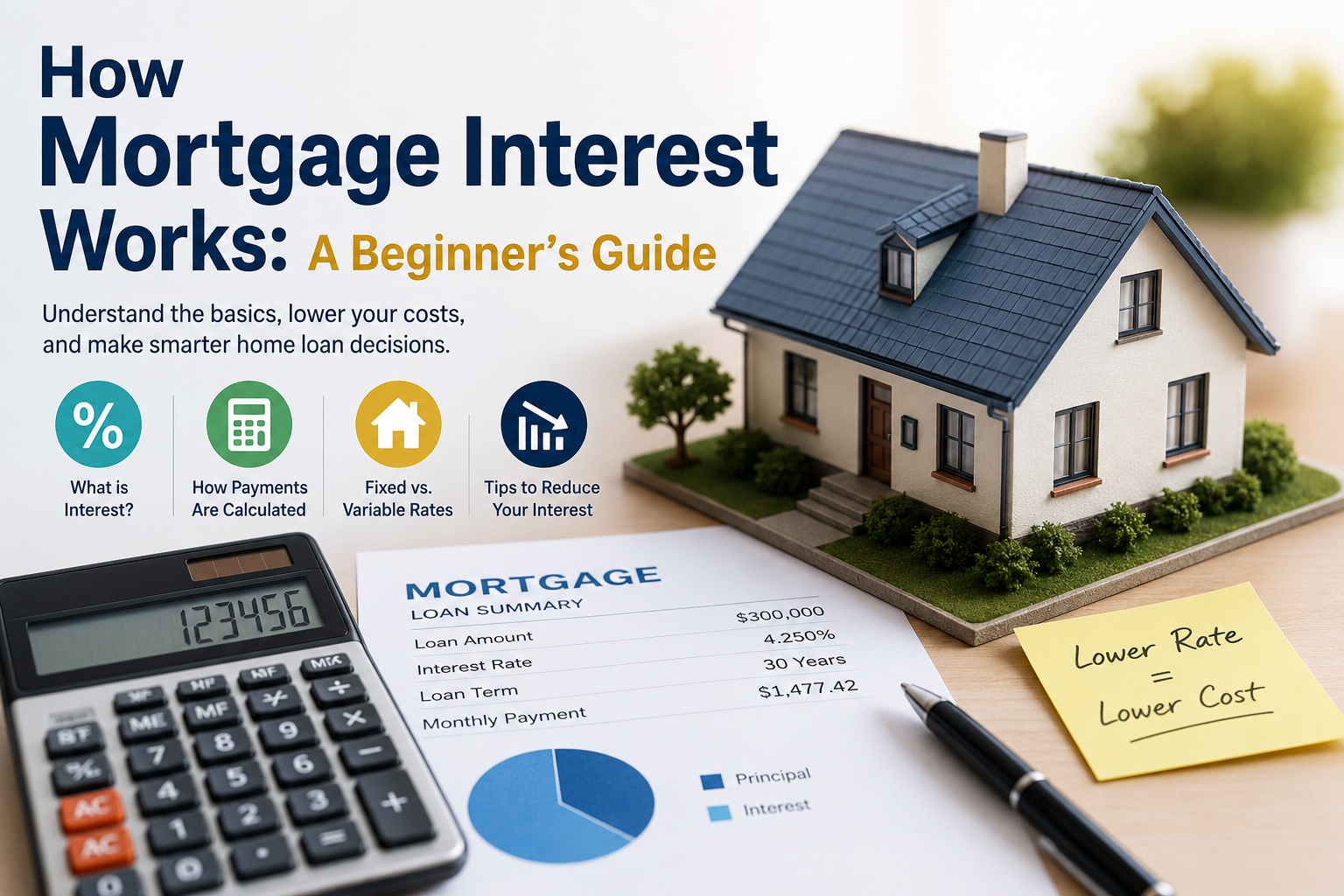
How Mortgage Interest Works : A Beginner’s Guide
Mortgage interest is one of the biggest costs of buying a home, yet many first-time buyers are unsure how it works. In this article you know How Mortgage Interest Works. Understanding mortgage interest can help you make informed decisions, compare loan offers, and estimate the true cost of homeownership.
Whether you’re planning to buy your first home, refinance an existing mortgage, or simply want to learn more about home loans, understanding the basics is an important first step. Mortgage interest affects your monthly payment, the total amount you repay over the life of the loan, and how quickly you build equity in your home.
If you’re ready to estimate your payments, try our Free Mortgage Calculator or Mortgage Calculator to see how different loan amounts, interest rates, and repayment terms can affect your monthly costs.
What Is Mortgage Interest?
Mortgage interest is the amount a lender charges for allowing you to borrow money to purchase a home.
When you take out a mortgage, you agree to repay:
- The amount you borrowed (called the principal)
- The interest charged on that borrowed amount
Think of interest as the cost of borrowing money. The lender provides the funds to buy your home, and in return, you pay interest over the life of the loan.
For example, if you borrow $300,000, you will repay the original $300,000 plus additional interest according to your loan agreement.
The exact amount of interest you pay depends on several factors, including your loan amount, interest rate, repayment term, and how quickly you repay the loan.
Why Do Lenders Charge Interest?
Lending money involves risk.
When a bank or mortgage lender provides a home loan, it expects to earn income from the interest charged. Interest helps lenders:
- Cover operating costs
- Offset lending risk
- Earn a return on the money they lend
Different lenders may offer different interest rates based on market conditions and your financial profile.
Understanding the Principal
The principal is the original amount borrowed before interest is added.
For example:
- Home price: $450,000
- Down payment: $90,000
- Mortgage amount: $360,000
In this example, $360,000 is the principal.
Each monthly mortgage payment typically reduces the principal while also paying some interest.
How Mortgage Interest Works
Mortgage interest is calculated based on the remaining loan balance.
At the beginning of your mortgage, the balance is at its highest. As a result, a larger portion of your monthly payment usually goes toward interest.
Over time, as you repay the principal, the remaining balance becomes smaller. This means the interest portion of each payment generally decreases, while more of your payment goes toward reducing the principal.
This gradual shift helps homeowners build equity in their property over the life of the loan.
What Is an Interest Rate?
An interest rate is the percentage charged on the outstanding loan balance.
For example, if your mortgage has a 6% annual interest rate, the lender charges interest based on that percentage according to the loan terms.
A lower interest rate generally means:
- Lower monthly payments
- Less interest paid over time
- Lower overall borrowing costs
Even a small difference in interest rates can significantly affect the total amount repaid over a long-term mortgage.
Mortgage Interest vs. Mortgage Payment
Many people think mortgage interest and mortgage payments are the same, but they are different.
Mortgage Interest
This is the cost of borrowing money.
Mortgage Payment
Your monthly mortgage payment may include:
- Principal
- Interest
- Property taxes (if collected with the payment)
- Homeowners insurance (if included)
- Other required fees, depending on your loan
Understanding this difference makes it easier to estimate your true housing costs.
Fixed-Rate Mortgages
A fixed-rate mortgage has an interest rate that stays the same for the entire loan term.
This means your principal and interest payment remains predictable throughout the repayment period, making budgeting easier.
Many homebuyers choose fixed-rate mortgages because they provide long-term payment stability.
Adjustable-Rate Mortgages (ARMs)
An adjustable-rate mortgage (ARM) starts with an interest rate that may remain fixed for an initial period before changing according to the terms of the loan.
Depending on market conditions and the loan agreement, future payments may increase or decrease.
Because payments can change over time, it’s important to understand how an ARM works before choosing this type of mortgage.
Why Mortgage Interest Matters
Mortgage interest affects more than just your monthly payment.
It can influence:
- How much home you can comfortably afford
- The total cost of your mortgage
- Your long-term financial planning
- The amount of equity you build over time
Taking time to understand mortgage interest can help you compare loan offers more confidently and choose a mortgage that fits your financial goals.
Factors That Affect Your Mortgage Interest Rate
Not everyone receives the same mortgage interest rate. Lenders evaluate several factors before deciding what rate to offer. Understanding these factors can help you improve your chances of qualifying for a better loan.
Credit Score
Your credit score is one of the most important factors.
A higher credit score generally shows lenders that you have a strong history of managing debt responsibly. As a result, you may qualify for a lower interest rate.
A lower credit score may result in a higher interest rate because lenders consider the loan to involve greater risk.
Improving your credit score before applying for a mortgage could help reduce your borrowing costs.
Down Payment
The size of your down payment can also affect your mortgage.
A larger down payment reduces the amount you need to borrow. This lowers the lender’s risk and may help you qualify for a more favorable interest rate.
A smaller down payment increases the loan amount, which may lead to higher monthly payments and additional loan requirements.
Loan Term
The loan term is the amount of time you agree to repay the mortgage.
Common loan terms include:
- 15 years
- 20 years
- 30 years
A shorter loan term usually means:
- Higher monthly payments
- Less interest paid over the life of the loan
A longer loan term generally results in:
- Lower monthly payments
- More interest paid over time
Choosing the right loan term depends on your financial goals and monthly budget.
Loan Amount
The total amount you borrow can influence your mortgage.
Larger loans involve higher monthly payments and more total interest over the life of the mortgage.
Before choosing a home, calculate how much you can comfortably afford rather than borrowing the maximum amount available.
Market Interest Rates
Mortgage rates change over time.
Economic conditions, inflation, and financial markets all influence the interest rates offered by lenders.
Because rates fluctuate, two people applying for similar mortgages at different times may receive different offers.
Type of Mortgage
Different mortgage products may have different interest rates.
Examples include:
- Fixed-rate mortgages
- Adjustable-rate mortgages (ARMs)
- Government-backed loans (where available)
- Conventional mortgages
Understanding the features of each mortgage type can help you choose the option that best fits your financial situation.
How Monthly Mortgage Payments Are Determined
Your monthly mortgage payment depends on several factors working together.
These typically include:
- Loan amount
- Interest rate
- Loan term
If applicable, your monthly payment may also include:
- Property taxes
- Homeowners insurance
- Mortgage insurance
- Other required fees
The exact components depend on your loan agreement and lender.
Example Scenario
Imagine you purchase a home with the following details:
- Home Price: $400,000
- Down Payment: 20%
- Loan Amount: $320,000
- Loan Term: 30 Years
The lender calculates your monthly payment using the loan amount, the agreed interest rate, and the repayment period.
If you increase the down payment or qualify for a lower interest rate, your monthly payment may decrease.
Likewise, selecting a shorter loan term generally increases the monthly payment but can reduce the total interest paid over the life of the loan.
To explore different scenarios, use our Free Mortgage Calculator or Mortgage Calculator and compare multiple loan options in just a few seconds.
Fixed-Rate vs. Adjustable-Rate Mortgages
Choosing the right mortgage is about more than finding the lowest interest rate. You should also understand how your interest rate may change over time.
Fixed-Rate Mortgage
A fixed-rate mortgage keeps the same interest rate throughout the loan term.
Advantages
- Predictable monthly payments
- Easier budgeting
- Protection from future interest rate increases
Considerations
- Initial interest rate may be higher than some adjustable-rate mortgages
- Less flexibility if market rates decrease
Many homeowners prefer fixed-rate mortgages because they offer long-term stability.
Adjustable-Rate Mortgage (ARM)
An adjustable-rate mortgage usually begins with a fixed interest rate for an introductory period. After that period ends, the rate may change according to the terms of the loan.
Advantages
- Lower introductory rate in some cases
- Lower initial monthly payments
Considerations
- Future payments may increase
- Budgeting becomes less predictable
- Total borrowing costs depend on future rate adjustments
Before choosing an ARM, carefully review the loan terms so you understand when and how the interest rate can change.
Why Comparing Mortgage Offers Matters
Many buyers focus only on the advertised interest rate.
However, comparing multiple loan offers can help you understand the overall cost of borrowing.
When comparing mortgages, consider:
- Interest rate
- Loan term
- Monthly payment
- Required down payment
- Closing costs
- Loan features
Looking at the complete picture can help you choose a mortgage that fits both your current budget and your long-term financial plans.
Common Misunderstandings About Mortgage Interest
Many first-time buyers have misconceptions about mortgage interest.
Here are a few common examples:
“A lower monthly payment always means a cheaper loan.”
Not necessarily.
A longer loan term can reduce the monthly payment while increasing the total interest paid over time.
“Interest is the same every month.”
Not always.
For many mortgages, the portion of your payment going toward interest gradually changes as you reduce the outstanding loan balance.
“The first mortgage offer is always the best.”
Not necessarily.
Comparing offers from multiple lenders may help you find a loan that better suits your financial needs.
Tips to Reduce the Interest You Pay
Although mortgage interest is part of every home loan, there are practical ways to reduce the total amount you pay over time. Small financial decisions today can make a noticeable difference throughout the life of your mortgage.
Improve Your Credit Score Before Applying
Lenders often consider your credit history when determining your mortgage interest rate.
Before applying for a mortgage, you may want to:
- Pay bills on time.
- Reduce outstanding debt.
- Check your credit report for errors.
- Avoid applying for unnecessary new credit.
Improving your credit profile may help you qualify for better loan terms.
Save for a Larger Down Payment
A larger down payment reduces the amount you need to borrow.
This may:
- Lower your monthly payment.
- Reduce the total interest paid.
- Improve your borrowing position with some lenders.
Saving for a larger down payment takes time, but it can reduce your long-term borrowing costs.
Compare Multiple Lenders
Mortgage rates and loan terms can vary between lenders.
Before making a decision, compare:
- Interest rates
- Loan terms
- Closing costs
- Fees
- Loan features
Looking at several offers helps you understand which mortgage best fits your financial situation.
Choose a Loan Term That Matches Your Goals
Different loan terms have different advantages.
A shorter loan term usually means:
- Higher monthly payments
- Lower total interest
A longer loan term generally offers:
- Lower monthly payments
- Higher total interest over the life of the loan
Choose the option that balances affordability with your long-term financial plans.
Make Extra Principal Payments (If Allowed)
Some homeowners choose to make additional payments toward the principal balance.
Reducing the principal more quickly may reduce the amount of future interest because interest is generally calculated on the remaining loan balance.
Before making extra payments, review your loan agreement to understand whether any conditions or restrictions apply.
Common Mortgage Interest Mistakes
Understanding common mistakes can help you make more informed borrowing decisions.
Focusing Only on the Monthly Payment
A lower monthly payment can be appealing, but it doesn’t always mean the mortgage will cost less overall.
Always consider both the monthly payment and the total cost of the loan.
Borrowing More Than You Can Comfortably Afford
Just because a lender approves a larger loan doesn’t necessarily mean it’s the right choice for your budget.
Consider your:
- Monthly income
- Living expenses
- Emergency savings
- Long-term financial goals
Buying within your budget can reduce financial stress.
Ignoring Additional Housing Costs
Owning a home often involves expenses beyond your mortgage payment.
Examples include:
- Property taxes
- Homeowners insurance
- Maintenance and repairs
- Utilities
- Homeowners association (HOA) fees, if applicable
Planning for these costs helps you build a realistic household budget.
Not Comparing Loan Offers
Accepting the first mortgage offer without comparing alternatives may cause you to miss a loan that’s a better fit.
Taking time to review multiple options can help you make a more informed decision.
Frequently Asked Questions:
What is mortgage interest?
Mortgage interest is the cost of borrowing money to purchase a home. It is paid to the lender in addition to repaying the original loan amount.
What is the principal?
The principal is the amount of money you borrow before interest is added.
Why do mortgage interest rates vary?
Interest rates can vary depending on factors such as your credit profile, loan amount, loan term, down payment, market conditions, and the lender’s policies.
Does a larger down payment reduce interest?
A larger down payment reduces the amount you borrow. This may lower your monthly payment and reduce the total interest paid over the life of the loan.
Is a shorter loan term always better?
Not necessarily.
A shorter loan term generally reduces total interest but usually results in higher monthly payments. The right choice depends on your financial goals and budget.
What is the difference between fixed-rate and adjustable-rate mortgages?
A fixed-rate mortgage keeps the same interest rate throughout the loan term.
An adjustable-rate mortgage may have an interest rate that changes according to the terms of the loan after an initial fixed period.
Can I pay off my mortgage early?
Some borrowers choose to pay extra toward the principal balance. Whether this is beneficial depends on your financial situation and the terms of your mortgage agreement.
Review your loan documents or speak with your lender before making additional principal payments.
How can a mortgage calculator help?
A mortgage calculator estimates your monthly payment based on information such as:
- Home price
- Down payment
- Loan amount
- Interest rate
- Loan term
It allows you to compare different borrowing scenarios before applying for a mortgage.
Final Thoughts
Mortgage interest is an important part of every home loan. Understanding how it works can help you compare loan offers, estimate monthly payments, and make informed financial decisions.
While the interest rate is an important factor, it’s only one part of the overall borrowing picture. Your loan amount, repayment term, down payment, and financial goals all influence the total cost of homeownership.
Whether you’re buying your first home or planning your next move, taking time to understand mortgage interest can help you borrow with greater confidence.
If you’d like to estimate your own payments, use our Free Mortgage Calculator or Mortgage Calculator to explore different loan amounts, interest rates, and repayment terms.
Sources & References:
This article is based on general mortgage concepts and educational information. For current mortgage regulations, lending requirements, and official guidance, consult authoritative sources such as:
- Consumer Financial Protection Bureau (CFPB)
- U.S. Department of Housing and Urban Development (HUD)
- Federal Housing Administration (FHA)
- Fannie Mae
- Freddie Mac
Finance Calculator
No posts
Most recent Our Guide
No posts