How Does an EMI Calculator Work? Formula and Examples
Planning to borrow money for a home, car, personal expense, or another major purchase? Understanding your monthly loan payment before applying can help you manage your budget and avoid taking on more debt than you can comfortably afford.
An EMI calculator helps you estimate the fixed monthly payment required to repay a loan over a specified period. EMI stands for Equated Monthly Instalment. It typically includes both principal repayment and interest, assuming a standard fixed-rate loan with monthly payments.
In countries such as the United States, the United Kingdom, and Canada, similar tools are commonly called monthly loan payment calculators. Whatever the name, the purpose is the same: to help you understand the cost of borrowing before you commit.
In this guide, you will learn how an EMI calculator works, which information you need, how the formula is calculated, and how to interpret your results.
What Is an EMI Calculator?
An EMI calculator is an online financial tool that estimates how much you need to pay each month to repay a loan within a selected repayment period.
You generally enter three main values:
- Loan amount: The amount you plan to borrow.
- Annual interest rate: The yearly interest rate charged by the lender.
- Loan tenure: The period over which you will repay the loan.
The calculator uses these inputs to estimate your monthly payment, total repayment amount, and total interest payable.
For example, if you borrow $20,000 at an annual interest rate of 6% for five years, an EMI calculator can estimate the monthly payment required to repay the loan over 60 monthly instalments.
The exact payment offered by a lender may differ because of fees, insurance, variable interest rates, payment timing, or other loan conditions.
How Does an EMI Calculator Work?
An EMI calculator uses a mathematical formula to calculate the payment needed to repay the loan principal and interest over the chosen period.
For a standard loan with a fixed interest rate and equal monthly payments, the calculation follows these steps.
Step 1: Enter the loan amount
Enter the principal amount you want to borrow. This is the original amount of the loan, excluding any additional fees that are not financed as part of the principal.
For example, suppose you plan to borrow $20,000.
Step 2: Enter the annual interest rate
Enter the annual interest rate expressed as a percentage.
For this example, assume the annual interest rate is 6%.
To calculate monthly payments, convert the annual rate into a monthly rate:
Monthly interest rate = Annual interest rate ÷ 12
Therefore:
6% ÷ 12 = 0.5% per month
In the EMI formula, the monthly rate is expressed as a decimal:
0.5 ÷ 100 = 0.005
This conversion is essential because the payment is calculated monthly.
Step 3: Enter the loan tenure
Choose the repayment period. The tenure determines how many monthly payments you will make.
For a five-year loan:
Number of monthly payments = 5 × 12 = 60
A longer repayment period usually reduces the required monthly payment, but it can increase the total interest paid over the life of the loan.
Step 4: Calculate the monthly payment
The calculator combines the principal, monthly interest rate, and number of payments to estimate the fixed monthly instalment.
It then uses the monthly payment and loan details to calculate the total amount repaid and the total interest cost.
EMI Calculator Formula
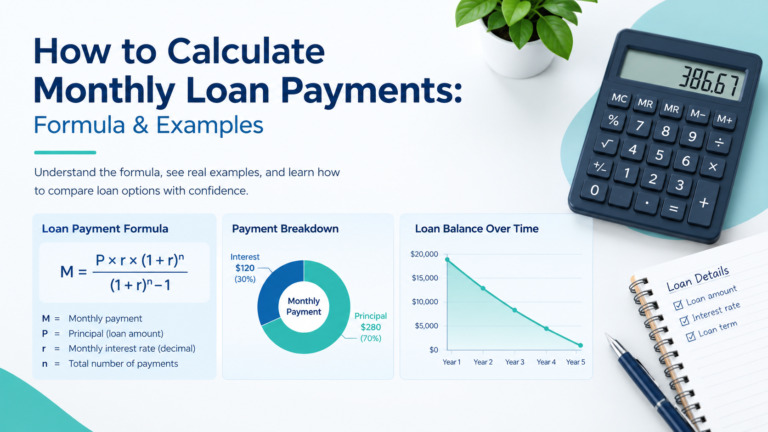
For a standard fixed-rate loan with equal monthly payments, the EMI formula is:
EMI = P × r × (1 + r)ⁿ ÷ [(1 + r)ⁿ − 1]
Where:
- EMI = monthly loan payment
- P = principal loan amount
- r = monthly interest rate expressed as a decimal
- n = total number of monthly payments
For example, if the annual interest rate is 6%, the monthly interest rate is 0.005. If the loan lasts five years, the total number of payments is 60.
The formula calculates a monthly payment that covers the interest charged during each period and gradually repays the principal.
Important: This formula assumes a positive interest rate, a fixed rate throughout the loan, and regular monthly payments. A zero-interest loan is a special case in which the monthly payment is the principal divided by the number of payments.
Worked Example: Calculate a Monthly Loan Payment
Suppose you want to borrow $20,000 with the following loan terms:
| Loan detail | Value |
|---|---|
| Loan amount | $20,000 |
| Annual interest rate | 6% |
| Loan tenure | 5 years |
| Number of monthly payments | 60 |
| Estimated monthly payment | $386.66 |
| Estimated total repayment | $23,199.60 |
| Estimated total interest | $3,199.60 |
These figures are illustrative and rounded. Actual lender calculations may vary slightly.
What does this example mean?
You would pay approximately $386.66 each month for 60 months.
The total of those payments would be approximately $23,199.60. Since you originally borrowed $20,000, the difference of approximately $3,199.60 represents the interest paid over the repayment period.
The example assumes a fixed 6% annual rate, monthly compounding for payment calculations, and no additional fees or charges.
What Results Does an EMI Calculator Show?
An EMI calculator may display several useful results.
1. Monthly payment
This is the estimated amount you must pay each month to meet the repayment schedule.
2. Total repayment amount
This is the sum of all scheduled monthly payments over the full loan tenure.
Total repayment = Monthly payment × Number of payments
3. Total interest payable
This represents the interest paid over the full repayment period.
Total interest = Total repayment − Principal
These figures help you compare different loan amounts, interest rates, and repayment periods.
4. Principal and interest breakdown
For many standard loans, the proportion of each payment allocated to interest and principal changes over time.
At the beginning of the loan, a larger share of the payment may go toward interest. As the outstanding principal decreases, more of the payment generally goes toward repaying the principal.
This is known as amortization.
How Does the Interest Rate Affect Your Monthly Payment?
The interest rate is one of the main factors affecting the cost of a loan.
When the loan amount and tenure remain unchanged, a higher interest rate generally means a higher monthly payment and greater total interest expense.
For example, compare two loans with the same principal and repayment period:
- Loan A has a lower annual interest rate.
- Loan B has a higher annual interest rate.
Loan B will generally cost more because interest is charged at a higher rate on the outstanding balance.
Even a relatively small rate difference can matter over a long repayment period. Before accepting an offer, compare the interest rate, fees, repayment terms, and total cost rather than looking at the monthly payment alone.
How Does Loan Tenure Affect EMI?
Loan tenure is the length of time allowed to repay the loan.
A longer tenure generally reduces the monthly payment because the repayment is spread over more months. However, interest may accumulate over a longer period, increasing the total cost of borrowing.
A shorter tenure usually means higher monthly payments but can reduce the total interest paid.
Consider these two options for the same loan amount and interest rate:
- Shorter tenure: Higher monthly payments and potentially lower total interest.
- Longer tenure: Lower monthly payments and potentially higher total interest.
The best option depends on your budget, financial goals, and the terms offered by the lender. A payment that looks affordable over a long period may still result in a much higher total repayment.
How to Use an EMI Calculator on TibCal
You can use TibCal’s EMI calculator to estimate your monthly loan payments before comparing financing options.
Follow these steps:
- Open the EMI calculator on TibCal.
- Enter the amount you plan to borrow.
- Enter the annual interest rate.
- Select the repayment period in months or years, depending on the calculator’s available inputs.
- Calculate the result.
- Review the estimated monthly payment, total repayment, and total interest.
- Change one input at a time to compare different loan scenarios.
For example, try a shorter repayment period and then a longer one. Compare the monthly payment and total interest to understand how the tenure changes the overall cost.
Common Mistakes to Avoid When Using an EMI Calculator
An EMI calculator is useful, but the results are only as reliable as the inputs and assumptions.
Using the wrong interest rate
Check whether the lender quotes an annual nominal rate, an effective annual rate, or another rate measure. These are not always interchangeable.
Confusing months with years
A five-year repayment period equals 60 monthly payments, not five payments. Make sure the tenure is entered in the correct unit.
Ignoring additional charges
Some loans include arrangement fees, origination fees, insurance costs, or other expenses. A basic EMI calculation may not include them.
Looking only at the monthly payment
A lower monthly payment does not necessarily mean a cheaper loan. Compare the total repayment and total interest as well.
Assuming every loan has a fixed rate
Some loans have variable interest rates. If the rate changes, your actual payment or repayment schedule may change too.
Forgetting about affordability
Before taking a loan, consider your income, regular expenses, existing debt, emergency savings, and other financial commitments. A calculator estimates payments; it does not determine whether a loan is suitable for your circumstances.
EMI Calculator vs. Loan Amortization Calculator
These calculators serve related but slightly different purposes.
An EMI calculator primarily estimates the regular monthly payment and overall repayment cost.
A loan amortization calculator typically provides a more detailed schedule showing how much of each payment goes toward principal and interest and how the outstanding balance changes over time.
If you want a quick estimate, an EMI calculator may be sufficient. If you want to understand the repayment schedule month by month, an amortization calculator can provide more detail.
Frequently Asked Questions
What does EMI stand for?
EMI stands for Equated Monthly Instalment. It refers to a regular monthly payment used to repay a loan, typically covering both principal and interest.
How is EMI calculated?
For a standard fixed-rate loan, EMI is calculated using the principal amount, monthly interest rate, and total number of monthly payments. The formula determines the equal payment required to repay the loan over the chosen period.
Does a higher interest rate increase EMI?
Yes. When the principal and tenure remain the same, a higher interest rate generally increases the monthly payment and total interest cost.
Does a longer loan tenure reduce EMI?
Generally, yes. Spreading repayment over more months usually lowers the required monthly payment, although the total interest paid may increase.
Can I calculate EMI without interest?
Yes. For a loan with no interest and equal monthly payments, divide the principal by the total number of payments.
For example, a $12,000 interest-free loan repaid over 24 months would require payments of $500 per month, before any additional fees.
Is an EMI calculator accurate?
An EMI calculator can provide a reliable mathematical estimate when you enter correct information and the calculator’s assumptions match the loan terms. Actual lender payments can differ because of fees, rate changes, payment dates, rounding, or other contractual details.
Is EMI the same as a monthly mortgage payment?
They are similar concepts, but terminology varies by country and loan type. A mortgage payment may include principal and interest, and some arrangements also collect property taxes, homeowners insurance, or other costs. A basic EMI calculation may not include those additional expenses.
Can I use an EMI calculator for a car loan or personal loan?
Yes. A standard EMI calculator can estimate payments for many fixed-rate car, personal, and other amortizing loans. Check that the calculator supports the relevant loan structure and fees.
What happens if I repay a loan early?
Early repayment may reduce future interest, depending on the loan terms and when the repayment occurs. Some lenders charge prepayment or early-settlement fees. Check your loan agreement before making additional payments.
Should I choose the lowest EMI available?
Not necessarily. Consider the total interest, loan tenure, fees, affordability, and flexibility of the repayment terms. The lowest monthly payment may come with a longer repayment period and a higher overall cost.
Final Thoughts
An EMI calculator is a practical way to understand monthly loan payments before borrowing money. By entering the principal, interest rate, and repayment period, you can estimate your monthly payment, total repayment, and overall interest cost.
Use the results to compare different loan scenarios, test whether payments fit your budget, and prepare questions for your lender. Remember that a calculator provides an estimate rather than a guarantee of the final amount you will pay.
Explore TibCal’s finance calculators to compare loan scenarios and make more informed financial decisions.
Disclaimer: This article is for general educational purposes only and does not constitute financial advice. Calculations are estimates and may not include lender fees, insurance, taxes, or other charges. Review the terms of any loan and consult a qualified financial professional if you need personalized guidance.