Mortgage vs. Home Loan: Differences, Costs & Calculations
Buying a property is one of the biggest financial decisions you may make. Whether you are purchasing your first home, moving to a larger property, or borrowing against a home you already own, understanding your financing options can help you make a more informed decision.
The terms mortgage and home loan are often used interchangeably. In many situations, they refer to the same type of borrowing: money borrowed to buy a property and secured against that property. However, the precise terminology can vary by country and lender.
A home equity loan is different. It allows an existing homeowner to borrow money using the equity in their property as collateral.
In this guide, you will learn how mortgages and home loans differ, what costs to consider, how monthly payments are calculated, and when a home equity loan may be relevant. You can also use TibCal’s Mortgage Calculator to estimate payments and interest costs.
Quick Answer: Mortgage vs. Home Loan
A mortgage is a loan secured by real estate. It is commonly used to finance a home purchase or refinance an existing property loan.
A home loan is a broad term for borrowing related to residential property. In everyday use, it often means the mortgage used to buy a house or apartment.
A home equity loan is a separate type of borrowing that allows a homeowner to access some of the equity built up in an existing property.
The key distinction is that mortgage describes a loan secured by property, while home loan is often a general term for borrowing to purchase a home. The terms are not always separate financial products.
What Is a Mortgage?
A mortgage is an agreement between a borrower and a lender. The lender provides money to purchase or refinance a property, and the property secures the debt.
The borrower agrees to repay the amount borrowed, plus interest and any applicable fees, according to the loan agreement. If the borrower fails to meet the repayment obligations, the lender may have legal rights to enforce the security, potentially including foreclosure or repossession, depending on local law.
Most standard home-purchase mortgages include the following elements:
- Principal: The amount borrowed from the lender.
- Interest rate: The cost of borrowing the money.
- Loan term or repayment period: The period over which the loan is scheduled to be repaid.
- Monthly payment: The regular amount paid toward principal and interest, plus other costs where applicable.
- Down payment or deposit: The amount the buyer contributes toward the purchase price.
- Collateral: The property securing the loan.
For example, if you purchase a property for $300,000 and contribute a $60,000 down payment, you may need to borrow $240,000, before accounting for any fees or financed costs.
You can use the TibCal Mortgage Calculator to estimate the monthly principal-and-interest payment for your planned borrowing amount, interest rate, and loan term.
What Is a Home Loan?
A home loan generally refers to money borrowed to purchase residential property. Depending on the country and lender, it may be used as another name for a mortgage.
For example, someone in the UK or India may commonly refer to a loan used to buy a home as a home loan, while a borrower in the United States may more commonly call it a mortgage.
A typical home-purchase loan works like this:
- You choose a property and agree on a purchase price.
- You contribute a down payment or deposit.
- A lender assesses your income, credit history, debts, and other eligibility factors.
- If approved, the lender provides financing under agreed terms.
- You repay the loan, usually through regular instalments.
The exact eligibility rules, required deposit, interest-rate structure, and fees depend on the lender and the country.
Important: A home loan used to purchase a property is not the same as a home equity loan. A home equity loan uses the value you have built up in an existing property to secure additional borrowing.
Mortgage vs. Home Loan: Key Differences
In many markets, a mortgage and a home-purchase loan describe essentially the same borrowing arrangement. The following table compares how the terms are generally used.
| Feature | Mortgage | Home Loan |
|---|---|---|
| Meaning | A loan secured by property | A general term for borrowing to purchase a home |
| Typical purpose | Buying or refinancing property | Purchasing a residential property |
| Security | Usually secured against the property | A home-purchase loan is usually secured against the property |
| Repayment | Usually regular payments over an agreed term | Usually regular payments over an agreed term |
| Interest rate | Fixed, variable, or another permitted structure | Depends on the product and lender |
| Additional costs | Interest, lender fees, and property-related costs | Similar costs may apply |
| Terminology | Commonly used in the US, Canada, and UK | Common in everyday use and in markets such as India |
The distinction is mainly about terminology and context rather than two universally separate loan products.
If you are comparing actual offers, focus on the loan agreement, annual percentage rate (APR) where applicable, fees, repayment schedule, rate-change rules, and total borrowing cost instead of relying on the product name alone.
Mortgage vs. Home Equity Loan
A home equity loan is a more meaningful comparison because it serves a different purpose from a standard home-purchase mortgage.
A home equity loan allows a homeowner to borrow against the equity in a property. The lender may provide the borrowed amount as a lump sum, which is repaid according to the loan agreement.
Home equity borrowing may be used for eligible expenses such as home improvements or other financial needs. However, using your property as security creates a significant risk: failure to repay may put your home at risk.
| Feature | Home-Purchase Mortgage | Home Equity Loan |
|---|---|---|
| Main purpose | Buy or refinance a property | Borrow against equity in an existing property |
| Existing ownership | Commonly used when purchasing a home | Generally requires an existing property with sufficient equity |
| Amount borrowed | Based on the purchase or refinance transaction and lender approval | Based on property value, existing secured debts, and lender rules |
| Security | Property being financed | Existing property |
| Repayment | Usually regular instalments | Usually regular instalments |
| Possible costs | Interest, appraisal, legal, closing, and other applicable fees | Interest, appraisal, legal, administrative, and other applicable fees |
| Main risk | The property may be at risk if you default | The property may be at risk if you default |
To estimate payments for this different type of borrowing, try TibCal’s Home Equity Loan Calculator.
Do not assume that a home equity loan is automatically cheaper or more suitable. Compare its interest rate, fees, repayment term, and effect on your existing mortgage before borrowing.
How Much Does a Mortgage or Home Loan Cost?
The cost of a home loan includes more than the advertised interest rate. Your total cost depends on the amount borrowed, the rate, the repayment period, lender fees, and other expenses associated with buying or financing the property.
1. Down Payment or Deposit
The down payment is the portion of the property price that you pay upfront.
For example, if a property costs $300,000 and you pay 20% upfront:
- Property price: $300,000
- Down payment: $60,000
- Amount borrowed: $240,000
A larger down payment generally reduces the amount you need to borrow. Depending on the country and loan program, it may also affect mortgage insurance requirements or the interest rate offered.
2. Interest
Interest is the cost charged by the lender for providing the loan.
The total interest you pay depends on the principal, interest rate, repayment schedule, and time taken to repay the debt. A higher interest rate generally increases the cost of borrowing, while a longer repayment period can increase the total interest paid.
3. Lender and Closing Fees
Depending on the location and loan product, you may need to pay fees such as:
- Loan origination or arrangement fees
- Property appraisal or valuation fees
- Legal or conveyancing fees
- Title-related fees or insurance where applicable
- Mortgage registration or recording fees
- Other lender or closing charges
Ask your lender for an itemized breakdown so you can compare the full cost of different offers.
4. Mortgage Insurance
Some mortgage products require insurance or a similar protection charge. The rules vary by country and loan program.
For example, certain US mortgages may require private mortgage insurance when the down payment is below a specified threshold. Other countries have different mortgage insurance systems and eligibility rules.
Include any applicable insurance cost when estimating your overall housing budget.
5. Property Taxes and Home Insurance
Property taxes and homeowners’ insurance are separate from principal and interest, but they can significantly affect the cost of owning a home.
Some lenders collect certain expenses through an escrow or similar account. Others require the homeowner to pay them separately.
For a realistic budget, consider your full housing expenses, not just the mortgage payment.
How to Calculate Monthly Mortgage Payments
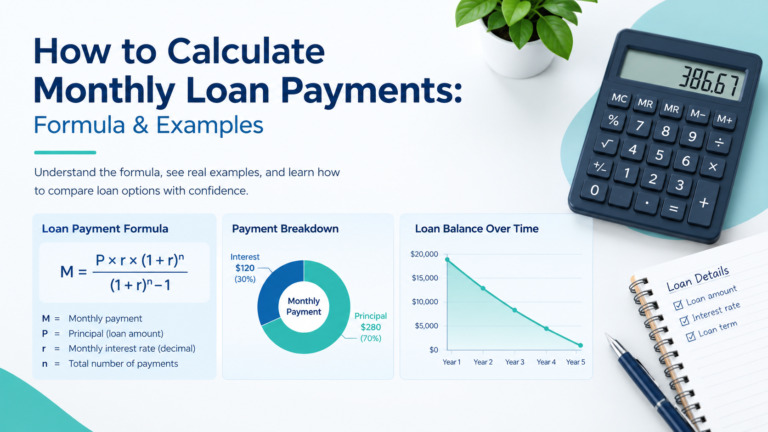
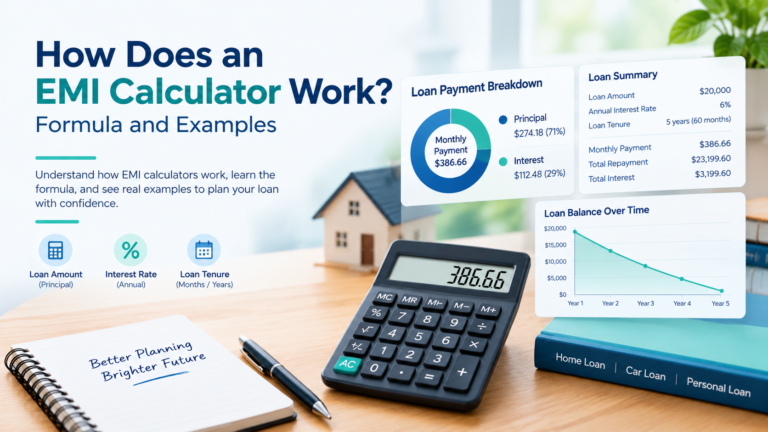
A standard fixed-rate mortgage payment can be estimated using the amortizing loan formula.
[M=P\frac{r(1+r)^n}{(1+r)^n-1}]
Where:
- (M) = Monthly principal-and-interest payment
- (P) = Amount borrowed
- (r) = Monthly interest rate, expressed as a decimal
- (n) = Total number of monthly payments
To calculate the monthly rate, divide the annual nominal interest rate by 12. For example, an annual rate of 6% gives a monthly rate of 0.06 ÷ 12 = 0.005, or 0.5%.
To calculate the number of payments, multiply the number of years by 12. A 30-year repayment period has 360 monthly payments.
This formula assumes a standard fully amortizing loan with a fixed interest rate and equal monthly payments. Actual lender calculations may differ because of compounding conventions, payment dates, fees, insurance, taxes, and other contract terms.
Worked Example: A $240,000 Mortgage
Suppose you borrow $240,000 under these illustrative assumptions:
- Loan amount: $240,000
- Annual interest rate: 6%
- Repayment period: 30 years
- Number of monthly payments: 360
- Interest rate type: Fixed
- Additional fees, taxes, and insurance: Excluded
Using the standard monthly payment formula:
| Calculation | Estimated Result |
|---|---|
| Monthly principal-and-interest payment | $1,438.92 |
| Total of 360 payments | $518,010.96 |
| Total interest over 30 years | $278,010.96 |
These figures are estimates and may differ slightly due to rounding. They do not include property taxes, homeowners’ insurance, mortgage insurance, or closing costs.
The example illustrates why it is important to compare both the monthly payment and the total interest over the full repayment period.
For a calculation based on your own loan amount, rate, and term, use the Mortgage Calculator.
How to Use TibCal’s Mortgage Calculator
You can estimate your mortgage payment in a few steps.
- Open the calculator: Visit the TibCal Mortgage Calculator.
- Enter the loan amount: Use the amount you expect to borrow, rather than the full property price if you are making a down payment.
- Enter the interest rate: Use the annual rate from your lender’s offer or a clearly labelled estimate.
- Choose the repayment term: Enter the applicable number of years or months supported by the calculator.
- Calculate the result: Review the estimated monthly payment and any other outputs displayed.
- Compare scenarios: Change the rate, loan amount, or term to understand how your payment and borrowing cost could change.
Before relying on a result, check which expenses the calculator includes. If property taxes, insurance, and lender fees are not included, calculate those separately for your budget.
How to Calculate Home Equity
Home equity is the difference between the current value of your property and the outstanding balances of loans secured against it.
A simplified formula is:
Home equity = Current property value − Outstanding secured debt
For example, suppose your home is currently worth $350,000 and your outstanding mortgage balance is $220,000.
Home equity = $350,000 − $220,000 = $130,000.
This means you have approximately $130,000 in equity before selling costs and other relevant adjustments.
However, your equity is not necessarily the amount you can borrow. Lenders may apply maximum loan-to-value limits, affordability checks, credit requirements, valuation rules, and other restrictions.
To explore a potential home equity loan payment, use the TibCal Home Equity Loan Calculator.
Mortgage vs. Home Loan: Which One Should You Choose?
If you are purchasing a property, compare home-purchase loan offers based on the full financial terms rather than whether a lender calls the product a mortgage or home loan.
Consider these factors before making a decision:
Compare interest rates and APR. Where available, APR can help you understand certain borrowing costs beyond the nominal interest rate. Check which fees are included and how the figure is calculated.
Check the repayment term. A longer term usually lowers the required monthly principal-and-interest payment but may increase the total interest paid.
Review rate-change rules. A fixed-rate loan offers greater certainty about the interest rate during the fixed period. A variable-rate loan may change with market conditions and could increase your payments.
Calculate your upfront costs. Account for the down payment, closing costs, moving expenses, and an emergency reserve.
Understand early repayment conditions. Some loans impose charges or restrictions when you repay early, refinance, or end the agreement before a specified date.
Borrow against equity cautiously. A home equity loan adds debt secured by your property. Consider whether the borrowing purpose justifies the cost and risk.
The most suitable product depends on your financial circumstances, location, property, and the terms available to you.
Mortgage and Home Loan Terminology in the US, UK, and Canada
Terminology and regulations vary across countries.
- United States: “Mortgage” is commonly used for a home-purchase loan. Borrowers may also encounter home equity loans and home equity lines of credit (HELOCs).
- United Kingdom: “Mortgage” is the common term for borrowing to purchase a property. Buyers often refer to an upfront payment as a deposit.
- Canada: “Mortgage” is the usual term for a property-secured home-purchase loan. Mortgage terms, renewal arrangements, and qualification rules can differ from those in the US and UK.
These are general descriptions, not complete summaries of each country’s mortgage law. Always check the applicable lender terms and local rules.
Common Mistakes to Avoid
Comparing only the monthly payment
A low payment may result from a longer repayment term, which can increase total interest. Compare the total repayment amount as well.
Forgetting additional housing expenses
Property taxes, insurance, maintenance, and applicable mortgage insurance can make the true cost of homeownership much higher than the principal-and-interest payment.
Confusing a mortgage with a home equity loan
A standard home-purchase mortgage helps finance a property purchase. A home equity loan lets an existing homeowner borrow against property equity. The purpose, eligibility criteria, and costs can differ.
Assuming a quoted interest rate is guaranteed
An advertised rate may depend on creditworthiness, deposit size, loan type, and other conditions. Confirm the rate and terms in your lender’s formal offer.
Borrowing the maximum amount available
Approval for a particular loan amount does not necessarily mean it fits your budget. Allow for changes in income, unexpected repairs, and other financial commitments.
Frequently Asked Questions
Is a mortgage the same as a home loan?
Often, yes. In everyday usage, both terms can describe borrowing to purchase a home. The exact terminology depends on the country, lender, and product. A mortgage specifically involves property securing the debt.
Is a home loan cheaper than a mortgage?
Not necessarily. If both terms refer to the same type of loan, the name does not determine the cost. Compare the interest rate, APR where applicable, fees, repayment term, and total amount payable.
What is the difference between a mortgage and a home equity loan?
A mortgage commonly finances the purchase or refinancing of a property. A home equity loan allows an existing homeowner to borrow against equity in their property. Both can be secured by real estate, and failure to repay may put the property at risk.
How much mortgage can I afford?
Affordability depends on your income, existing debts, deposit, credit profile, interest rate, property expenses, and lender requirements. Start with a realistic monthly housing budget and use a calculator to compare possible loan amounts. A calculator estimate is not a lender approval.
Does a longer mortgage term reduce the monthly payment?
Usually, yes. Spreading repayment over more months generally reduces the required monthly principal-and-interest payment, assuming other factors remain the same. However, it typically increases total interest over the life of the loan.
What costs should I include when comparing mortgages?
Compare interest and applicable lender fees, valuation and legal costs, mortgage insurance, property taxes, homeowners’ insurance, and any early repayment charges. Some costs are paid upfront, while others recur during ownership.
Can I borrow against the equity in my home?
Possibly. Eligibility depends on your equity, income, existing debts, credit profile, property valuation, and lender rules. A home equity loan uses your property as collateral, so missed payments can have serious consequences.
Which TibCal calculator should I use?
Use the Mortgage Calculator to estimate payments for a mortgage or similar home-purchase loan. Use the Home Equity Loan Calculator to explore payments for borrowing against existing home equity.
Conclusion
Mortgage and home loan are often two names for the same basic borrowing arrangement: financing a home purchase with a loan secured by property. A home equity loan is different because it allows an existing homeowner to borrow against the equity in their property.
When comparing financing options, look beyond the product name. Review the interest rate, repayment period, upfront fees, ongoing housing costs, and total interest you may pay.
Use TibCal’s Mortgage Calculator to estimate your monthly payments and compare repayment scenarios. If you already own a property and are considering borrowing against its equity, try the Home Equity Loan Calculator.
Disclaimer: This article provides general educational information, not financial, legal, tax, or mortgage advice. Calculator results are estimates and do not guarantee loan approval or a particular lender offer. Confirm actual rates, fees, and repayment terms with a qualified lender or adviser in your jurisdiction.
References
- Consumer Financial Protection Bureau: What Is a Home Equity Loan?
- Financial Consumer Agency of Canada: Choosing a Mortgage
- Financial Consumer Agency of Canada: Borrowing Against Home Equity